Stories from our Early Years
In the early days of REES, every project felt like new ground. We were learning, experimenting and finding our place. Looking back, what stands out most is the way those projects shaped who we became. Hospitals that balanced need with possibility, television studios that earned national recognition and clients who gave us the chance to prove ourselves all played a part in our story. Those early years were about building relationships, taking our chances and discovering what was possible with design. The stories that follow capture a few of those defining moments. They remind us how the first chapters of REES continue to influence us 50 years later.

A Living Room, A Drafting Table and A Plan
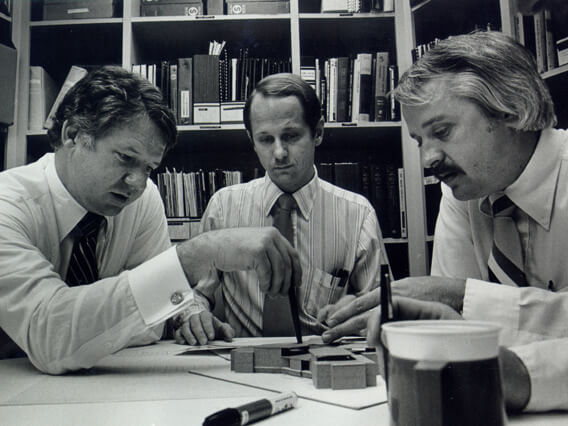
Frank Rees’ work at Benham and Blair got him noticed. When a key leader was tapped to lead an international effort, Frank was selected to fill his position. Several of the more senior team members weren’t excited about the energetic, 32-year-old architect stepping into the role. The conflict led to Frank wondering if his future might be elsewhere.
He took a two-week vacation and traveled to the West Coast to pursue projects that Benham and Blair had previously passed on pursuing. He returned with three healthcare master plan projects and a looming decision. With the encouragement of his wife, Joanie, and a vision for what a different kind of architecture firm could be, Frank resigned from Benham and Blair. On November 26, 1975, Frank and Joanie sat in their living room to file the Articles of Incorporation and create their new firm. The name would be Rees Associates, Inc., a name chosen to showcase stability.
That day, I wrote a three-year plan, but I had no vision that the firm would one day be fifty years old.
Frank Rees
“That day, I wrote a three-year plan, but I had no vision that the firm would one day be fifty years old,” Frank reflected.
For a while, the staff was Frank and an answering service. He rented a drafting table, hired a secretary who worked evenings after her day job and rented space from Loftis and Bell architects month-to-month.
It was important to Frank that he was not seen as poaching clients from his previous employer. He committed to securing his first ten projects outside Oklahoma and the first 20 outside Oklahoma City. Many of those first projects came through partnerships with companies like CIT Financial and the Tandy Corporation. These companies would provide hospitals financing or technical help. REES would handle the master plans.
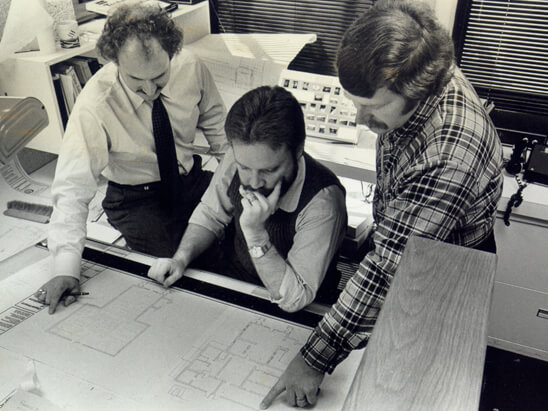
As the contracts got bigger and more time consuming, Frank brought in a few former colleagues to moonlight after hours. Slowly, what started in a living room with borrowed time and rented space became something real that would grow for the next 50 years and beyond.


The other firms were talking about how big they were and all their experience. I talked about the client’s problems and how to solve them, that… made all the difference.
Frank Rees
From Insight to Broadcast Legacy
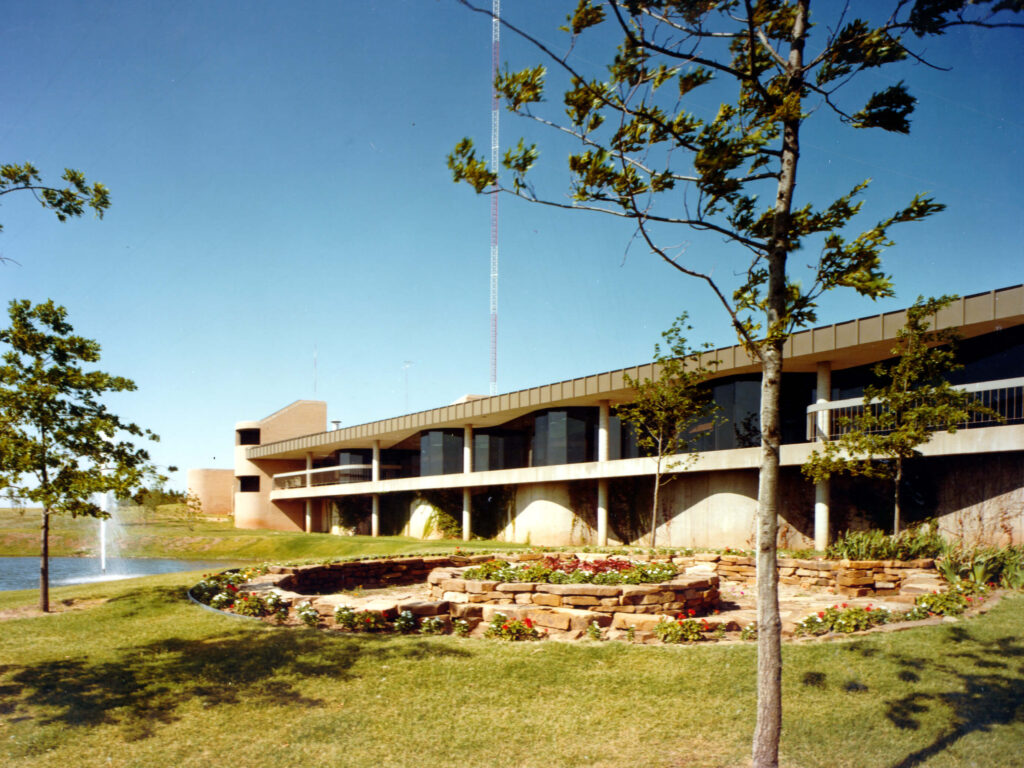
KOCO-TV in Oklahoma City was looking to build a new station. While television stations weren’t a project type Frank Rees was entirely familiar with, he had enough insight to understand their business. Before REES was REES, Frank wasn’t an architect with a portfolio but a radio salesman with a rolodex. In college, he sold advertisements at one of the radio stations in town; he later became sales manager at another.
Interested in the project, Frank decided to call their general manager. But he wasn’t making a cold call. He was reaching out to someone he knew. The two were previously competing ads salesmen—Frank in radio, the general manager in television.
“He remembered me,” Frank recalled. “I’d tried to sell him advertising packages back in the day, and he said, ‘So you’re really a designer now, an architect?’”
REES got a shot to interview for the project, alongside two of the largest firms in Oklahoma. But unlike the others, Frank walked in with industry experience. He talked about his knowledge of the industry, REES’ masterplan process and the risks of locating the station too closely to the transmission towers. The guywires would form six-foot-long icicles in the winter. Frank sketched out a site plan during the pitch that avoided the danger of falling icicles smashing into the building or people.
Frank remembers, “The other firms were talking about how big they were and all their experience. I talked about the client’s problems and how to solve them, that… made all the difference.”
That mix of Frank’s insight and listening to the client’s needs landed REES the job. It opened the door to decades of broadcast work.

The Hospital Built to Withstand
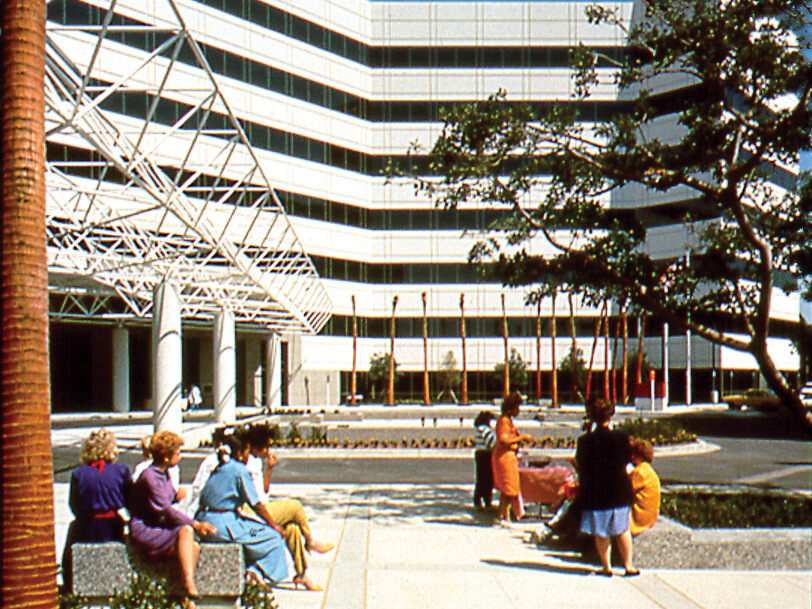
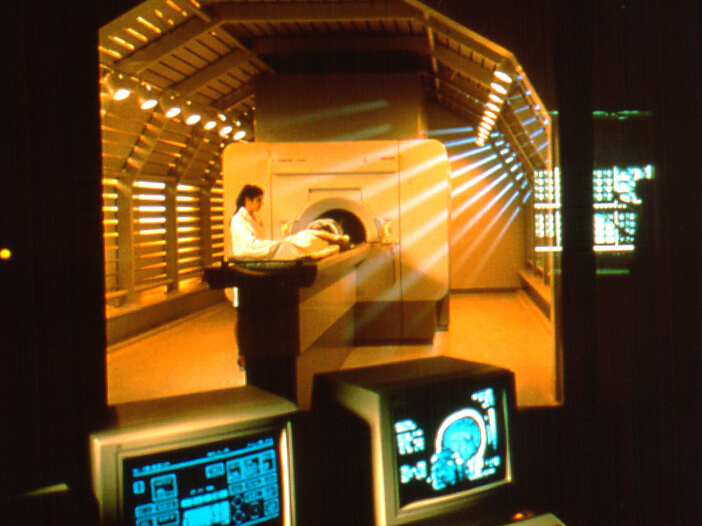
When the University of Southern California set out to build a new teaching hospital in Los Angeles, they had more than patient care in mind. It had to survive an earthquake with a magnitude of 8.2 on the Richter scale. REES designers were put to the test on how to make an eight-story, 340,000-square foot hospital survive a high magnitude earthquake.
REES proposed an interesting solution: seismic base isolation. The building would sit on rubber and-lead shock absorbers, allowing the structure to remain nearly still while the ground moved beneath it. During an earthquake, the system could absorb up to six inches of ground shift, then re-center the hospital once the vibrations stopped. The design included seismic plates beneath the structure and huge expansion joints between the hospital and the surrounding ground. This would give the building room to move without taking damage. It also required less steel in the upper floors and a simpler foundation system overall, which would save costs without compromising performance.
It was the first hospital in the nation to be built using the seismic-base isolation system.
Dennis Metheny, project architect
“It was the first hospital in the nation to be built using the seismic-base isolation system,” recalled Dennis Metheny, REES project architect.
“We had to convince people with the state of California that this new system would work.”
The test arrived quickly. Shortly after the hospital opened, in 1994, the Northridge Earthquake rocked the area. The seismic event brought chaos to surrounding hospitals, forcing them to close or curtail patient services. Engineers reported $13 billion in damage to freeways and other structures.
However, for the staff and patients within the USC University Hospital, they felt “nothing more than a gentle rocking,” according to the LA Times, “with patients saying that it was as if they were babies again, back in their cradles.”
“The building did its job,” said Dennis.
This real-world test of USC University Hospital was hailed by many as positive proof in seismic base isolation technology’s potential to protect all types of critical infrastructure in California.
Not only did the hospital’s solution create a safer, more efficient building, but it began a widespread conversation about the use of this proactive design approach to save lives and eliminate damage.